
 If you’ve ever had the pleasure of upgrading old electrical wiring in a residence, you know that a separate earth ground wire was generally not used in the past. In such cases, you find yourself with 2 wires: live, and neutral.
Now, you might want to install a grounded outlet without redoing a lot of wiring. A common method of getting around this little problem is to install the new 3-conductor outlet by tying live to one prong, neutral to the other prong, and then using a jumper wire to connect neutral to the ground connection inside the outlet.
“Theoretically, this should work just fine!” you reason.
It turns out that theoretically, you are in fact correct. Practically speaking, adding a “ground” in a 2-wire installation by tying neutral and ground together has several serious – and possibly dangerous – drawbacks.
Here’s the scoop.
This here post assumes that you actually have some idea of how AC power systems work. Obviously, if you know very little about AC wiring and power distribution systems, you need to do some serious homework first before you get yourself killed. You can check out the following links:
[ad name=”banner”]
Alrighty, now that that’s out of the way, here’s the deal. In a standard AC electrical scheme, there is a generator that spits out 3 phases of AC. Those phases are then fed to transformers, through high-voltage power lines over vast distances, through another local transformer to step down the voltage, and then into the main panel in your home. From there, you have wiring to your power outlets. Simple enough, yes?
Right. So there you are, and you have an old 2-wire system. Maybe in your main panel, you don’t even have circuit breakers – you might have fuses if your system is really old. Alternatively, if a bonehead electrician rewired your place at some point, you might have breakers and still have 2-conductor wiring everywhere. If your electrician is really bad, you could even have differential circuit breakers with no ground wires anywhere.
A differential breaker, or Ground Fault Circuit Interrupter (GFCI), uses an inductor to “measure” the current flowing through both the neutral and live wires. Normally, the currents flowing through both wires will be equal, and thus all is well. If, however, there is an equipment failure and/or live is shorted to ground through a human body, then obviously the currents through live and neutral will not be equal. At that point, the current imbalance (i.e. the current differential) trips the breaker, and power is cut. Since the trip current for such breakers is typically 30mA, and it takes somewhere around 200mA to stop a human heart, you can go ahead and drop your hairdryer into the bathtub with you and you won’t die. Sweet!
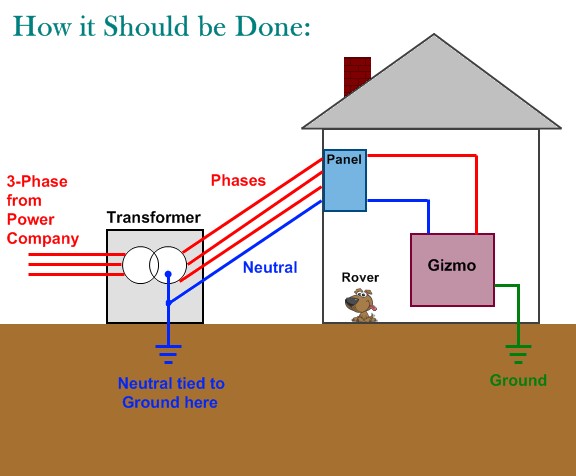
Okay, now comes the reason why using neutral as ground is NOT the best idea. The following is a typical electrical hookup:
Click for larger version
Note that in our example, the house in question is connected to all 3 phases from the power company. This 3-phase setup is rare in highly populated areas – but quite common in rural areas in many countries! In single-phase setups, one house will be connected to Phase 1 from the transformer, the next house will be connected to Phase 2, and a third house will be connected to Phase 3, and all the houses will share the neutral line. Neutral is tied to ground because as the “common return point” for all three phases, the net voltage/current at that point is ideally zero. This is easy enough to see if you draw three sine waves, each 120° out of phase with each other, and add them together (see the homework links above for more info).
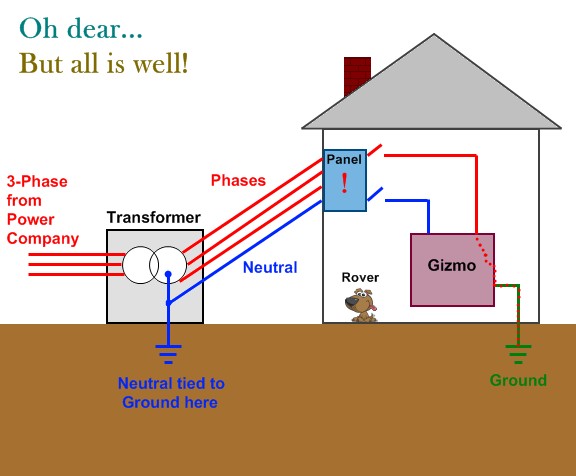
In any case, what happens when there is a fault in the gizmo? Let’s say that a fault occurs such that the live wire going into the electric gizmo is shorted to its metal casing. Since the metal casing is grounded, the fault current is shunted to ground as follows (look for the red dots):
Click for larger version
Here we see that the current is shunted to ground. When this happens, the differential breaker in the main panel detects that the current on the live is higher than the current coming back on the neutral wire. Thus, the breaker trips, and both live and neutral are cut off before anyone dies. This is a good thing.
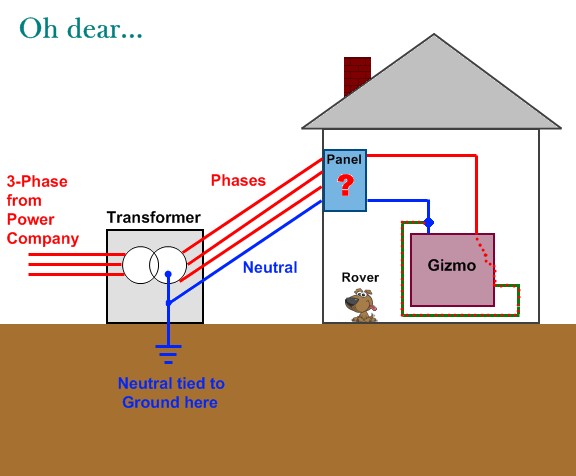
All right – so what happens when we have 2-conductor wiring, and we connect ground and neutral at the power outlet for our Gizmo? See below:
Click for larger version
Now things might begin to become a bit more clear. In this case, when the Gizmo has a fault condition and current is shorted from live to the “grounded” casing, ground = neutral since we tied those two lines together in the power outlet! Thus, the circuit is not broken because even if we have a differential breaker in the main panel, it will not trip since everything seems well as far as the breaker is concerned. That’s bad.
Of course, if the failed Gizmo draws too much current, the fuse or normal breaker in the main panel will blow/trip – but we’ve lost the protection from electrocution provided by the differential breaker, which is kind of important.
Note that under normal conditions, the casing IS actually connected to ground in this case – via the neutral line back to the transformer. In the USA, neutral is also tied to ground at the main panel in each home. Still, if you look again at the diagram above, that does nothing to improve the situation.
You may be wondering what the fuss is all about. After all, assuming that all is well, the neutral-connected Gizmo casing will not electrocute you since you would actually have to be grounded in order for any current to flow through you. Furthermore, even if you ARE grounded, your body would probably present a higher impedance path to ground than the neutral line that runs back to the transformer where it is connected to an actual earth ground. As we know, electrons will always seek the path of least resistance since they are, in a word, lazy. And, as I already mentioned, neutral is basically “zero” current/voltage since the neutrals of all phases are connected together with earth ground. So, what’s the big deal?
Well, you kind of have a point – theoretically speaking. The problem comes when all is not well. You cannot rely on the neutral staying connected to all three phases. A separate earth ground provides an added layer of protection under severe fault conditions even if the above theoretical scenario is true. For example, if neutral is temporarily disconnected for some reason – either in your house or at the electric company’s equipment – you’ve got a problem. In fact, you’ve got a seriously big problem because at that point, power surge conditions can cause pretty big problems. When your Gizmos start to explode due to power spikes as a result of load imbalances in the 3-phase system, and there is no ground to save you, you’re in big trouble.
Granted, there are other safety systems in place. Granted, the aforementioned severe fault condition should be almost nonexistent in a well-maintained electrical system. But that brings up the whole point of a separate ground: safety! By connecting neutral and ground at the outlet, at the very least you are effectively disabling any human safety mechanisms present in the electrical installation in your home. At worst, you are asking for disaster – rare though such occurrences may be.
So, if you want to play it safe (and you do!), add a ground line to your 2-wire setup instead of connecting neutral and ground. Install differential circuit breakers for your own protection.
Theory is good, but practicality and safety is better.
Going the DIY route? Grab some test equipment!






WELL WRITTEN TUTORIAL ON ELECTRICAL SAFETY
Hi,
I hope you can help me with my CVT’s (constant voltage transformer) earth/neutral connection. The input to CVT requires the earth to be connected to the body. In the CVT’s output – the earth is tied to neutral. Effectively, only two wires, i.e. live and neutral connects to my audio power amplifier.
Since my audio power amplifier requires earth/ground connection, I then connected the earth pin of my amplifier to the house earth wire which runs into the ground separately.
Recently, a EE friend of mine asked me to remove the ground from the neutral at the CVT output level.
Are there any advantages by connection earth and neutral in relation to EMI?
Thank you.
Tony
Not that I know of. Generally speaking, an actual earth ground is best for EMI shielding. The closer the earth connection is to the device, the better. Then again, EMI is not exactly my specialty, so I could be wrong!
Thanks for the reply. Unfortunately, if I remove the earth from the neutral my tester says ” No earth”. My electrician says there”s nothing wrong with the wiring but couldn’t explain why tester shows no earth.
The manufacturer emailed me this “Leaving the neutral to earth link in place is fine. It provides a zero volt reference for the output neutral. If you were to disconnect it, the output neutral would float at around 100V to 120V with respect to earth. Most people have the output neutral earthed.”
Not sure what should be the correct method. I asked my electrician to install another rod to the ground and connect that to the neutral of the CVT. At least now the tester says everything is normal.
Tony
hey scottie i somehow lost the neutral to my light fixture and used the ground instead of the neutral and the light works fine is this dangerous i would have to do a lot of cutting and patching to fix this correctly which i would like to avoid thanks
Theoretically, it will work, yes. But practically speaking, it’s a bad idea.
If your light was/is ever protected by a differential breaker (GFCI), it will trip a lot. In fact, you probably don’t have that lighting circuit protected with a GFCI breaker, because if you did, it should trip the instant you turn the light on. If it’s NOT tripping, then something is seriously wrong.
While it is true that neutral is tied to ground at different points in the grid depending on what country you live in, neutral is not ground for all practical purposes. Neutral is the “return line” for the AC, which means that theoretically, since all the neutral lines of the larger 3-phase power grid are tied together, neutral will basically be 0. But in practice, no grid is perfectly balanced, so it’s not 0. By using the ground as a neutral, you are essentially risking an energized ground, which defeats the actual purpose of the ground in your whole house. Neutral isn’t really “neutral”. By using the ground as a return, you are also counting on the earth’s impedance between your installation and the nearest neutral/gnd tie to remain constantly low, which of course it doesn’t, and instead depends on things like soil humidity and type.
In short, you might be able to get away with it, but it could result in big headaches and possibly even a shock hazard down the road. Better to go the cutting and patching route if you ask me!
What if i connect the ground terminal to the wall of my house? My house is grounded anyway. will that work.
Well, usually every outlet in the house is connected to the same ground point, that being a conducting rod driven into the ground. The composition and length of the rod will vary based on the type of soil, humidity, etc. in your area. If you have multiple ground points – even if they are only on opposite sides of your house, you can experience the very interesting problem of ground loops. Essentially, with 2 grounding points, there is no way to ensure that the potential of the earth at those two points is always the same. So, under certain conditions, you can have problems with electrical gizmos breaking or acting strangely because ground is no longer ground… or because ground on one side of the house is not the same as ground on the other.
The other thing is that grounding to your house may work, but it depends on what your house is made of, if the conductivity of the walls changes too much depending on temperature and humidity, and so on. So, the best option is to have 1 real grounding rod, and connecting everything to that 1 point. Other stuff MAY work, but it also may cause you headaches down the road.
I wonder if you can help. I’m in Spain, near Barcelona, where we use the 2-pin Schuko type plugs. Most of my electrical stuff is 3-pin UK wired and I use an adapter with an earth on it as the Shuko plugs have an earth pin (whether it does anything is another matter, how would I know???)
I am getting minor electrical shocks from my electrical devices when plugged in to all but a couple of the sockets. I imagine that neutral is not properly earthed. I also imagine that if I DO earth neutral the fuses will blow – there’s usually a reason why neutral is not properly earthed. My landladies are tight and will not pay for an electrician – much less pay for the place to be re-wired. We can’t even change the electricity bill into our name because it will require a safety certificate (which it doesn’t have and which no electrician would sign off meaning they would need to re-wire).
Is there a device you know of that I can plug in between my 4-way adapters and the offending power sockets to act as an earth? Even if I have to physically take a wire and attach it to a grounding rod, that would be better than getting current through the USB sockets on my laptop 🙁
So, do the outlets in the wall look like one of these: http://en.wikipedia.org/wiki/Schuko ??
If there are either the ground tabs, or the actual ground prong in the wall sockets, then ground should work – unless it isn’t wired properly inside the apartment. Some plug adapters don’t actually have a real ground prong – it’s just plastic. That’s bad juju. The other possibility is that the sockets are wired incorrectly, although that shouldn’t really cause a shock hazard if the ground is connected properly.
Assuming that your socket adapter is not goofy somehow, then it sounds like the wiring was not done properly. You could investigate and cut the power to one of the outlets at the breaker panel, and then remove the cover plate on the outlet and see if the ground prong/tab is even wired up. Sometimes in old buildings, owners will save money by removing old 2-wire (phase/neutral) lines and install grounded outlets without actually connecting the ground up to anything because they don’t want to pay an electrician to rewire everything. That’s seriously “illegal” according to the electrical codes of most EU countries, but then again in certain countries, you don’t actually HAVE to fix the wiring if the house/building is a certain age. It’s all kind of ridiculous, actually.
Worst case, you could run your own ground wire through a window or something and attach it to a grounding rod in the earth, but get a book or something on how to do it properly. The length of the rod, type of metal, diameter, average humidity level of the soil, etc. are all kind of important for a really good ground.
Hope this helps!
@Simon Brown
I have the same problem. I get a minor shock from my Aluminum Apple keyboard. I always have to wear slippers when using the computer. just like you I bought my mac from USA with 3 prong connections but in my country we have 2 prong connections.
Another idea would be to connect a power strip to the 2-prong outlet. Then, connect a wire to one of the ground prongs in the power strip to a bare copper cold water pipe. Generally speaking, water pipes act as an adequate ground. There’s no guarantee it will work well, and it requires that all pipes are conductive metal and not plastic somewhere in the building, but it might help. Oh, and one other thing: if with a 2-prong plug zaps you a bit, unplug it, and replug it the other way around (so that the prongs of the plug are in the opposite hole they were in before). That works well for things like metal touch lamps and such that give you a little “buzz” when you touch them.
@Scottie
Thank you so much for your help.
I tried the “plug it in the other way up” and still got shocks. I guess that means that neutral isn’t properly earthed on that spur. Spain is all done with spurs apparently – rather than loops like what they do in the UK.
From memory the power strips I’m using (which also contain surge protection) can be dismantled and I can solder in a wire to the earth – it will look a bit dodgy but don’t care – at least if I attach it to the central heating pipes I shouldn’t get shocks…
is it OK to short Neutral and Earth bus bar in the Distribution Panel?????
I think in the US, neutral is often tied to ground at the breaker panel. In Europe, it usually is not. I usually just go with whatever the local wiring standards indicate.
This article really helped me out. It is written so well! Thanks a lot mate.
Great article Scottie! I understand that neutrals should not be used as grounds. However, what is the reason for grounding the neutral at a panel which seems to be a very common practice in N.America?
@Benson
Sorry Scottie, just wanted to rephrase the question:
Why is it bad to connect the neutral to ground at a receptacle, but acceptable to do so at the main panel?
That’s a good question. Frankly, the only setup that actually makes sense to me is for the power company to ground neutral at the transformer, with no neutral-ground bonding at the panel. Anything else, and I would think you would run into ground loop problems. If you and your neighbor have neutral-ground bonds at your panel, and you’re basically sharing a neutral at the power company level, and naturally both of your “grounds” are at a slightly different potential, then this would theoretically cause ground/neutral loop currents that cause problems. Actually, now that I think about it some more, I’m not sure why neutral is ever connected to ground, because the same issue should arise with transformer neutral-ground bonding. Neutral is supposed to be 0V theoretically, but practically it never is. Maybe that’s exactly the reason why, but it doesn’t seem very practical or well-done to my engineering mind. “Ground” is never actually 0V. Ground there could be 200V higher than ground here. So, I’m perplexed as well! Will have to ponder this some more…
wish you can advise me. i had a situation at site, where there is an amount of earth leakage enough to trip my ELR at Distribution Board. this DB supply the power to my control power of MCC and Switchgear.
the strange part is, whenever i disconnect the protection relay earthing, things would be normal, no leakage occur. same thing happen when i short the neutral to earth.
what is actually the main problem behind this. what equipment cause this leakage. hope can advise.
I’m not totally familiar with all the equipment you’re using, but the principle of operation seems to be the same as an RCD/GFCI breaker in a residential installation (more or less). If you are disconnecting the ground of the entire installation from the actual grounding rods, that might stop the ELR from tripping if one or more devices are leaking current to ground inside the devices themselves. The same would happen by tying neutral to ground, because then the leaked current would flow back through the RCD/ELR/CBCT, there would be no imbalance, and thus no tripping.
The only thing I can think of is a problem I have seen before when using a 30mA RCD with lot of computer/electronic equipment. Since each computer, printer, switch, etc. leaks a small amount of current normally (usually due to clamping/filtering circuits), the total leakage current can normally hover close to the 30mA limit of the RCD. Any extra leakage that randomly occurs will trip the RCD (such as when a laser printer fires up to print). This is usually solved by using a 30mA “high immunity” RCD that is specifically designed to work with electronic gizmos that normally have a small amount of leakage current – or an RCD with a higher limit (like 100mA or whatever).
I’m not sure if this helps you at all, but for what it’s worth!
Thank you for the in-depth description of the problems regarding neutral and ground bonding. I fully understand the concerns this brings but I wanted to pose a different environment/case.
Suppose I have a 12V to 230V inverter for my car that only accepts euro plugs thus ungrounded. Being there a need to connect my laptop on it (grounded schuko plug) I wanted to ask… Putting on a “schuko” style socket wouldn’t be a problem and coupling negative and ground should be easy. But what are the risks in this case? The current isn’t strong enough to kill anyone (at least I don’t think it is) but what about the risks for the car and the computer? Thank you in advance for your reply.
I would just leave it ungrounded. The negative terminal in a car is considered the “ground”, as it is generally connected to the engine block and chassis, but that’s a far cry from an actual earth ground, which is what the laptop ground connection expects. I would use or make a schuko -> 2-prong adapter if necessary to power the lappy via the inverter. And actually, the ground is only for the power brick of the laptop, since the actual DC cable that plugs into the puter itself is just 2 wires, i.e. 19Vdc or whatever. So, worst case, something goes wrong and your lappy power brick keels over.
As for the current, that depends on the inverter… I have a car inverter that is 100W max output at 230V. That’s 100W/230V = 0.434 A. 0.3A is enough to stop the human heart at 230V, and possibly much less depending upon the specific situation and the health/age of the individual. Normal RCD/GFCI/differential breakers in household protection applications trip at 30mA, or 0.03A! Of course, trip time is also a factor, so it gets a bit more complicated, but that’s the gist of it.
At the end of the day, the inverter is connected to the +/- of the car, so it is already connected to the best “ground” available in the car. So, assuming it’s well-designed, you shouldn’t have any disasters.
@Scottie
Thank you very much for a quick and helpful reply. You cleared all doubts I had before. I would just like to ask if there even is a Scuko to 2-prong adapter? I don’t seem to find it anywhere. I would guess no one makes it since it’s not considered safe. I might be (hope to be) wrong…
My reply seems to have been lost by some random reason. Anyway, I was just saying thank you for clearing and doubts I had left and explaining how to resolve my issue.
I wanted to ask you if there is any way to find a 2-prong to schuko adapter out there? I don’t seem to find it browsing the www.
Again, thanks dude!
I would either use a travel plug adapter, or better yet grab a plug and socket of the appropriate type from the local hardware/home improvement store. I usually end up just making a short extension cord with plug on one end, and socket on the other. One time, I just lopped off the plug on the laptop AC power cord, and attached a different plug. Blue = neutral, Brown = phase, Green/Yellow = ground. In a standard French power outlet, for example (with an actual ground prong on top), phase is the right hole, and neutral is the left hole. I think schuko plugs are the same.
The extension cord is a great idea! Why didn’t I think of that?! I’m going to make one today. Thanks again for all your help. I took some time to read some other posts on here and I found a lot of useful ones. Favoring this site for sure!
Hi Scottie, so sorry to bother you again but I have another question. So I made the short extension cord to change the socket from 2 prong to a schuko. All is well and it works. The only difference I see is that the laptops power supply now emits a strange buzing noise. If I connecti it to a wall socket it’s absolutely quiet. I made a test enviroment at home first using a 230 to 12V inverter (reads 8A) and then connecting the 12V to 230V inverter for the car to the first inverter. Is the noise from the laptop power supply normal? Could it be dangerous for any person/appliance?
Hmm, generally speaking laptop power bricks should not make weird noises. I’m really not sure what’s going on. Does the lappy power brick make noise if you run it directly from the inverter plugged into a car? I’m thinking maybe the double inverter test setup is causing some kind of problem, but I just can’t think of exactly what the problem might be.
If you’re only powering the laptop, then technically you might just look at getting something like this: http://www.amazon.com/PWR-INSPIRON-Latitude-Portable-Notebook/dp/B002UI2Y8Q/
There are different models, and then you don’t have to worry about the 230V problem.
No, I did not try it in the car yet as I’m unsure what is going on. I know about the car chargers but this was meant to be a cheep-man alternative since I had the inverter lying around. I left the laptop rigged like this running it for a few minutes and it ran fine. We’ll see how it behaves in the car. If it buzzes in there too than I’m buying the car laptop charger. Better safe than sorry. Thx again for the effort.
Hey Scottie,
I’m stumped and need some fresh ideas. in january had my 240 single phase service upgraded from 50 amps to 100 amps.
my average consumption jumped from 1500 kwh/mo to 6000 immediately following the breaker change out.
i digress:
7 yrs of history makes my consumption he same year over year, 800 kwh/mo summer, 1500kwh/mo dead of winter.
they are using the same meter
they put a test meter to prove the meter is accurate
they rewired some grounds on the pole but 3 people agree they are all correct.
all the system has been triple checked for leaks or loads acting improperly.
in october i added more load and expected a 500kw /month increase
which i saw in october 800>1300, in november it went to 1550 (colder) in december was 880 (they said short billing cycle, january was 4900 (breaker changed january9th) february was 6000 and now march (no warmer than february) is tracking for 3300.
the power company is saying now that the old box must have had some kind of fault that was allowing unmetered power through and this is simply my consumption…seems ridiculously high though, and whil matematically possible, practically i don’t believe i’m using this kind of juice.
ideas?
Hi,
Well, it’s kind of hard to say without knowing what kind of loads you have in your house. At 800 kWh – unless my math is wonky – that’s about 4.8A at 230V continuous usage for 30 days. 1500 kWh would be 9A continuous usage at 230V for 30 days. 6000 would then be 36A.
But it really depends on what loads you have running, and when. If you have AC or electric heat, you’re in big trouble. If you just have some high-power loads running every now and then, well, something is definitely strange.
Also, I once rented an apartment. They kept claiming that I was using X number of kWh, but the problem was I was almost never there and the only thing running was a tiny little fridge. I ended up just paying the bill, moved out shortly thereafter, and that was that. But I always wondered what was really going on… IOW, was I paying for somebody else’s electric bill, because obviously I was not using anywhere near what they claimed I was using. That was an apartment building, and my meter was very old, while some others were brand new. I suspect there were other loads in the building connected to my meter that I wasn’t supposed to know I was paying for.
Another thing that occurs to me (although I think this is unlikely), is what kind of power was the old meter measuring, and what kind of power does the new meter measure? Usually, electric companies bill for real power consumed, i.e. V * A = W. But their generation systems and the grid must account for apparent power, which is related to power factor and how inductive and capacitive loads actually mean that the power company must generate 100W of juice in order to power your CFL bulbs (or whatever) that only use 50W of real power (W). These numbers are not really accurate, but just to convey the general idea… This is the real problem with CFL bulbs, because sure, they’re all low-power and such, but they’re also a real pain since they “unbalance” the grid due to higher apparent power. Businesses with huge motors and such either actually pay through the nose for their electricity, or they have active power factor correction equipment that adds/subtracts inductive and capacitive loads to their actual loads so that they aren’t penalized by the electric companies. For computer power supplies, you often see “Active PFC” in product descriptions, which is the same thing, used for the same reasons.
Well, like I said, normally power companies do NOT charge for apparent power, but rather real power, but I did hear some rumblings that this might change. Still, that wouldn’t account for such a huge increase in your consumption, unless you’re mostly running huge inductive loads (i.e. big motors) or huge capacitive loads (lots of things).
I can’t see how the ground would affect things, but you never know.
Sooooo… Well, what to do? Hmm… Probably what I would do is use an amp meter (clamp type) and go into the main panel and try to measure the loads vs. what appliances are running. Then I’d measure the total current flowing over the inputs to the main breaker. This should allow you to narrow it down to:
a) there IS some strange load, and now you know where/what it is
b) there is NOT some strange load, and the current into the main breaker is NOT high enough to account for your billed usage
c) there is NOT some strange load, and the current into the main breaker IS high enough to account for your billed usage; welcome to the Twilight Zone.
That would probably require multiple measurements, maybe a few times a day for a few days. Or do measurements for, say, 4 days out of the month when you know you are running your typical load types (i.e. Laundry Day, electric heat running a lot, fun with power tools in the garage, and “just lights, TV, and computer day”). Then using those measurements, figure out what your consumption for 30 days should be, and compare.
That’s about all I can think of at the minute.
hullo scottie
am wondering in the case of some unlucky fool getting shocked across live and natural at the same time and he/she is standing barefoot on the floor.
will the breaker trip due to the current flow to ground?
or will it not, because the live and neutral currents are absolutely equal?
Yes, an RCD/GFCI breaker will trip in that case. All things being equal, the currents in live and neutral will be basically the same for a given single-phase circuit. But neutral is also connected to all the other neutrals, no matter what phase (3-phase AC) you’re actually using as Live. In some countries, they connect neutral and ground at the breaker panel. In most other countries I’m aware of, they do not do this, but the neutral of high voltage 3-phase transformers is often grounded instead. That doesn’t mean neutral = ground, though!
Ideally, in a 3-phase system, neutral is the sum of the “return currents” for the 3 phases (lives), which mathematically adds up to 0V. It’s a bit strange and nebulous to imagine, but the easy way is to remember that the neutral in your house is connected to everybody else’s neutral eventually. Power plants produce 3 phases, and usually you have Phase 1 = this neighborhood/area, Phase 2 = that one, Phase 3 = another area. But you all share the same neutral. Those 3 phases are 120 degrees out of sync with each other. Neutral is the return for all 3. So, add 3 sine waves that are 120 degrees out of phase with each together, and you get… 0! That’s the mathematical ideal, however. Practically speaking, neutral is never 0V.
Neutral is a bit of an odd duck compared to the Live/Phase wire.
So, the ground fault in the example you gave would most likely be Live -> Person -> Floor. The GFCI thus detects an imbalance between Live and Neutral (since some of the return current that should be on the neutral is going through the person and into the floor). POOF! Your breaker trips.
That’s not to say that it’s totally safe to touch the Neutral wire in a live electrical installation… It’s still a current-carrying conductor, and in certain situations, you can get a nice shock from it!
Also, keep in mind that GFCI/RCD breakers are not foolproof. They are designed to trip before too much current leaks through a human being to ground. But, even with a GFCI breaker, you can still die from the shock even if it trips properly. It depends on many factors, including where the current traveled through your body, your mass, age, health, skin conductivity, etc.
MOST of the time, a GFCI will save your life. But don’t count on it!
thanks Scotty
im asking because im stuck on one theoretical question that nobody seems to be able to answer and because its stupid to try out for yourself
that is
if on a home 230v AC power socket, if a person would disengage the earth pin and then place a metal object on the live receptacle with one hand, and then another metal object on the neutral receptable with the other hand, standing barefoot on the floor, will the breaker trip?
from your theory, even if the breaker trips, a person could still be severly injured, have cardiac arrest or worst, die?
most ‘normal’ Live -> Person -> Floor shocks are non lethal i know, what about the example i gave above (ie live and neutral together).
dont worry im not up to something stupid, i just want to know the theory!
cheers!
Yup, you would get a shock, even if the earth pin was still connected. Without a GFCI/RCD, you would get a very deadly shock.
WITH a GFCI, it will trip after a certain teeny amount of time when the GFCI detects a certain amount of leakage current to ground. Thus, you still have a voltage across your body (thru your arms and possibly your heart, in your example), and a current flows. You still get a shock before the breaker trips, and it will vary from “Ouch!” to “Oh crap I’m dead!” At 230V, the amount of current required to fatally injure you is small, but not constant.
So, my point about including that little tidbit was just to say that GFCI/RCD’s increase the safety factor a LOT, but given how they work, they don’t mean your installation is 100% “electrocution-proof”.
@Scottie
wow, now i know thats one thing you should NEVER try ever!
its a good thing i asked, if i was a lot younger and there was no internet for information i believe myself (and some other curious folks here) could have been severely injured by trying that stunt!
cheers and thanks again!
thanks Scottie
now i know that situation should be avoided totally!
cheers
Hi, i have a taco truck in my shop that was built/wired improperly in another state. I have stripped everything out and re-wired the 110v circuits inside of the unit. The unit has a high wattage Honda genset that powers everything inside. I tested everything inside while the unit was plugged into shore-power in my shop. The GFI’s and all of the circuits worked perfectly. When the city came out to inspect it they wanted to see the power run through the genset. When I disconnected from the shop and started the genset, all was fine except that the GFI’s no longer worked. We failed their approval. I checked everything twice and found nothing wrong. I got on the internet and found out that these gensets have floating grounds. When I tied the neutral and grounds together at the circuit boards the GFI’s worked as they should and we then passed the test.
When Taco trucks are not in use there are stored at a commissary and are plugged in to shore-power. We can’t do that with this circuit set-up. What type of device can I install that will allow me to wire the wagon so that it can work from both power sources?
Well, that’s a fun problem! If I understand correctly, I think I’d get one of these. It’s just a 2-position, 3-pole switch, complete with fancy “Shore/Gen” settings. You can see the schematic for the switch here. The general idea would be that you switch Line, Neutral, and Ground (Ground = Line 2 in the schematic). When connecting the switch to the genset, tie Ground and Neutral together (so that Neutral from genset is connected to both Neutral and Line 2/Gnd on your switch, which would be pins 5 and 9 in the schematic). The output of this switch could then feed your panel with the GFIs. The max current for this switch is 65A. Also, it’s a BIT expensive! You could probably find one cheaper elsewhere, but that’s the general idea.
Helo, Scottie!
It is clear to me that the neutral wire and the groundning wire must not be interconnected, am I right?
Both systems must be separated, but is there any chance that there is any differential of potencial between the neutral and the grounding system? If so, would it be dangerous if I touch both wires at the same time? What would be a risky condition where the potential between neutral and grounding is lethal?
Thanks
Well, depending on where you live, neutral may even be tied to ground at the breaker panel. I believe they do that in the USA. European norms generally forbid tying neutral + ground at the breaker panel, but the neutral of high voltage transformers is commonly grounded at the transformer (which then feeds neighborhoods and such). That’s a simplification, but you get the idea.
Ideally, neutral is always 0V, and so is ground. Practically, that’s not the case. If you use a voltmeter and measure Phase-Neutral, and Phase-Ground, usually they will differ by a few volts up to tens of volts. That’s pretty normal. In the EU case I just gave, if neutral is connected to earth ground at the HV transformer, and your house is grounded at your house, than the 2 grounds are separated by a relatively large distance. The Earth isn’t 0V everywhere – it’s all relative. Stick 2 copper rods in the ground several meters apart, and you can often measure a small voltage. That’s the general idea of a “ground loop”.
Anyway, the main point is as I wrote in my article: earth ground is connected to gizmos in such a way that fault current is routed safely to the Earth itself. Neutral, on the other hand, is a different animal even if it is “theoretically” very similar. Neutral is the “common point” in 3-phase power generation, and since the 3 phases are each out of sync by 120 degrees with each other, they all “cancel”… theoretically.
As to lethal voltages between neutral and ground, I think that should happen only rarely given how things are usually connected. But, you never know! There are always “catastrophic failures” which cause all kinds of fun problems. 😉
Hi all, its my pleasure to be a part of these discussions here onwards..From INDIA..
@MySchizoBuddy
pls. check your 3 pin plug there is no earth connection is made inside power plug or your neutral wired may connected with earth,that is only reason of shock
The water company was digging in front of my house. In order to do so they disconnected my ground. Which in turn my home and everything electrical suffered a major power surge. Are they at fault? After all had they not disconnected my only ground it never would have happened.
Disconnecting the ground shouldn’t actually cause a power surge of any kind. It just removes the “safety net” in case of a fault condition (like a power surge). If disconnecting your ground caused the surge, then there is probably something seriously wrong with the wiring in your house. So, it’s hard to say exactly who or what was at fault.
okay, i’m sorry i wasn’t exactly right, you didn’t say there IS 200 volts measured to ground, you said the ground there COULD be 200 volts higher than ground here. ok, so there COULD be 200 volts measured at ground. do you really think that?
Well, what I actually said was:
The whole point of having a separate ground wire connected to your very own metal stick in the earth is that it provides an added layer of protection that does NOT depend on neutrals being tied to ground at the transformer, or at your panel, etc. Normally, with a neutral-as-ground setup, you could theoretically touch the neutral wire and not die (after all, it’s grounded – but DO NOT TRY THIS AT HOME!). Well, can you be sure? What if there’s a fault somewhere outside your house? The problem is not that it doesn’t work – it does. The problem is that the extra layer of protection afforded by an independent, local ground is missing. Having a real earth ground locally means that the safety of your installation is more independent in those (rare) instances when the power distribution system is not working like it’s supposed to.
Besides that, ground is used as the “dumping ground” for things like noise filters in electronic gizmos, and for those, a local ground is usually better anyway.
no, you have the wrong comment, this is the comment that i’m talking about. this is what you wrote ………….”That’s a good question. Frankly, the only setup that actually makes sense to me is for the power company to ground neutral at the transformer, with no neutral-ground bonding at the panel. Anything else, and I would think you would run into ground loop problems. If you and your neighbor have neutral-ground bonds at your panel, and you’re basically sharing a neutral at the power company level, and naturally both of your “grounds” are at a slightly different potential, then this would theoretically cause ground/neutral loop currents that cause problems. Actually, now that I think about it some more, I’m not sure why neutral is ever connected to ground, because the same issue should arise with transformer neutral-ground bonding. Neutral is supposed to be 0V theoretically, but practically it never is. Maybe that’s exactly the reason why, but it doesn’t seem very practical or well-done to my engineering mind. “Ground” is never actually 0V. Ground there could be 200V higher than ground here. So, I’m perplexed as well! Will have to ponder this some more…” read toward the end of that comment to see what i’m talking about.
Oh, that! Ground loops. They can be a real bitch. The idea that the earth is always 0V is simply not true. At a very basic level, 0V with respect to what? It’s relative, and there are a variety of factors that affect it. Stick 2 metal rods in the ground a few hundred meters apart, and measure the voltage across them. Sometimes, it’s 0. Other times, it’s very definitely NOT zero. Granted, 200V might have been a bit of an exaggeration for effect, but then again you never know.
But anyway, ground loops can be a very big problem in communications. In the olden days, you could string a serial data cable from one building to another, and ground it at both ends. We’re talking maybe 30ft apart. Guess what? The drivers on one or both ends would get toasted, because each building had it’s own ground, and this created a loop that allowed high enough induced currents to flow to fry the electronics. The solution was to disconnect the ground at one end. TA-DA! Problem solved.
So, I was thinking the same thing would certainly apply to the electrical grid. Grounding is nowhere near as simple as most people think. Even the type of ground rod one should install for a particular location depends on soil composition, soil humidity, position (sheltered from rain, or no?), etc.
individually grounded at each house is a system that seems to work fine. and if you think about it, it does make sense. a good way to understand ground and neutral within a house is this:
parallel wires connected to a common point. one is for normal use (the neutral) the other is there only for safety(the ground)
We have 3 phase 380 vac and neutral in our company . If i check phase to phase using multimeter i have 380vac and 220vac from phase to neutral . The problem is when checking ground to neutral i have 200vac is this normal or safe?
Hi scottie pls answer my question above it will realy help me alot. ☝☝☝
thank you
200Vac from ground to neutral? Seems a bit high to me. This page may explain what’s happening… As usual, the answer may not be a simple yes or no.
with regards to circuit designations, some AC circuits are labeled AC and ACC and Ground. I understand that AC is hot or input and ACC is return but what does the abbreviations “AC” and “ACC” stand for?
I’ve been wondering about this myself for awhile. You’re right, AC = phase and ACC = neutral. But where those abbreviations came from, I dunno. There is also DC and DCC, so maybe the extra “C” stands for “common”? Works for me!
the voltage between live and earth wire of my house is 110V, altough the voltage between live and neutral is 230V.can you please explain why?
Thanks.
Normally, assuming things are wired properly, you’d get something like this for a 230V single-phase connection (under load):
Neutral – Live = 227V
Neutral – Ground = 1V
Live – Ground = 228V
Live-Ground should be the highest voltage, which is actually Live -> Ground wire -> Ground rod in Earth-> back to transformer ground which is tied to Neutral. If the ground is good, and assuming that this ground wire/path will normally not have much current flowing through it, the voltage drop of this path is smaller than Live-Neutral. Thus, Live-Ground voltage is slightly higher than Neutral-Live.
Neutral-Ground should be 1 or 2V, which is actually Neutral -> back to transformer neutral which is tied to ground rod in Earth -> back to your local ground rod in Earth -> back to ground prong on outlet. Neutral current is ideally 0 in a 3-phase system, and every single-phase connection is simply one branch of a 3-phase system (IOW, all neutrals for all 3 phases are the same wire eventually). So, normally, a Neutral-Ground V measurement is more or less measuring the voltage drop of Neutral current flowing in the Neutral conductor.
Neutral-Live should be Live-Ground minus the Neutral-Ground, so 1 or 2V less than the proper voltage.
So, the question is: If you plug something in on the same circuit and run it (i.e. when the circuit is under load), what are the measurements for Neutral-Live, Neutral-Ground, and Live-Ground? And if nothing is plugged in on the circuit (if possible to test this), what are the same measurements?
@Scottie
Thank you for your response.
under no-load the measurements are: live-neutral 226V, live -ground 110V and neutral-ground 10V.
I haven’t been able to take readings with load.
Hmm… I’m trying to come up with an explanation that fits, but I’m drawing a blank.
So, I’d check that the ground is good. Then I’d make sure there aren’t any shared neutrals where there shouldn’t be, and/or ground connected to neutral somewhere. If there is some neutral wiring error, it can be quicker to track it down by continually measuring your “house” (not sure if you are measuring at a single power outlet, at the panel, or whatever), and then turn off breakers one by one.
Or, turn everything off, and then measure at the panel. If all is normal there between neutral/phase/ground, you know it’s something in the house wiring. Then proceed from there.
I have a problem that is driving me crazy. I bought a 2 bedroom house trailer that was a refugee from the wrecking ball( I saw potential) I gutted it out, wiring and all and when I rewired it I used the same panel and new breakers also upgrade the wiring too 12-2 as the old wiring was 14-2. All rooms are now on their own circuts with 20 amp breakers. When doing the wiring and the cable tv I made sure to run each line away from the other and into seperate bays in the walls. A electrian hired by the trailer park I live in was hired to repair my electrical box on the pole and now I am getting a 30 to 35 volt reading on the cable tv lines. So far I have blown 2 tv’s when I try to connect to the cable tv. I have checked my work in the electrical panel all grounds are securly tightened and the junction box in the media panel I installed for the cable tv is grounded. I alco checked the ground that is attached to my water pipe for the earth ground. I was going to try and send you a 2 photos of my electrical box on the pole but can’t get them to load on here. I will try and explain best I can, My original setup up had 2 100 amp breakers and they removed that and put in a single 100 amp breaker. To tie it onto the lines coming to my house they double looped the lines out of the bottom of the breaker ( don’t know how it is spliced, wrapped with tape ) they tucked the excess wire on each side of the box hooked my neutrals to each other on a junction block but did not ground the block. Could their farting around in the box be causing me to pick up stray voltage on my cable line even though they are not in direct contact? Thank oyu in advance for your answer. Jeffrey
2 things that seem a bit weird right off the bat:
1. There should only be 1 ground, and it should not be a water pipe. As far as I know, grounding should be from the neutral at the panel to a ground rod stuck in the earth. If there are any “ground wires” on water pipes, usually it’s only to jumper across a non-metal section of the water pipe (like if there’s a water meter installed inline that’s mostly plastic). But if you attach a ground rod and your water pipes as ground, you can end up with a ground loop, which may cause severe mayhem.
2. The neutral at the panel usually is grounded in N. America.
There definitely shouldn’t be 30-35V of induced voltage on the cable TV lines. You said the media panel is grounded, so I’m wondering if that ground isn’t really grounded.
Of course, there may be some wiring standards for trailers that I’m unaware of…
I sent you an e-mail, so maybe you can send those photos on!
Very good
Hi, I recently purchased a Lighting Panel Board with RCBO installed in it. I would like to use it in another country where the system is Multi ground _ Phase wire and a Ground (2 wire). Will I be able to use this panel and use the neutral to connect to the grounded wire and run another wire to connect to ground?
You should be okay. The RCBO will work regardless of a ground, since it’s just detecting any current imbalance between Phase and Neutral/Second Wire. Technically, Neutral and Ground are bonded somewhere in every country I know about – they just do it slightly differently in different places.
So, I would do Phase -> Phase, Neutral of Lighting Panel Board -> 2nd wire of supply, and then make my own ground rod + connection to any metal chassis or ground connection on the Lighting Panel Board. I think that’s what you described, and I think that will work nicely.
i have 2 wire romex in parts of old house. tying into one circuit. i am getting 31.7 volts between hot line and ground in 3 wire romex. if i install an earth ground to my grounded box in the new part will that correct that and is it safe?
I would check the existing ground setup. At 120V, 31.7V between hot and ground means your ground is nowhere near neutral potential (and it should be since neutral is bonded to ground at the panel in N. America). Hot-ground should be within a few volts of the hot-neutral measurement.
So, that’s definitely not normal, and might be due to some wiring error somewhere and a poor ground connection (including the actual grounding rod, which may need to be replaced).
If you install a new ground, disconnect the old one. If breakers start tripping, then you’ll know for sure you have a wiring fault somewhere.
i had an electrician “clean up panel. he found ground was not connected. he connected ground, still have 17 volts between hot and door frame next to box. tried to ground door frame, had 123 volts between hot leg and door frame.
If you measure between hot and ground in the 3-wire romex you mentioned earlier, and you get ~120V, then you should be all set. Who knows what kind of additional path to ground the door frame has. If you have a good panel ground, good wiring, and proper GFCIs installed, all should be well.
RCBOs
After reading your paper on AC circuit safety, Im cutting loose the Nuetral from the Ground Bar in my panels.
There is no Ground wire from the Utility Company here in Thailand in my area. At least not to my house.
This house is all 2-wire.
After a few shocks from the Air Con and Refrigerator, Microwave, washing machine, I started driving ground rods for every device and purchased RCBOs for the devices in question.
Yes Sir, These are current carrying nuetrals and they do bite hard at 240vac.
I broke the rules thinking I could act like the Utility Company and tie the Nuetral to Earth Ground, which you pointed out, would defeat the purpose of the RCBOs safety function. (1) Nuetral to ground Faults.
THxs for the ReEducation on Electrical Safety Course.
How can i create earth out of neutral?
Hello Scottie,
Hope you are still here.. This was a great article… Thank you very much.
I have a highly related issue at home. I live in a country where Earthing at home is virtually unknown. However, when I built my place, I wired it and connected to a triple rod earth pit.
Mains comes in at 380v 3-phase 4 wire supply. There is no utility ground coming in. I cannot be sure if Neutral is grounded at transformer. Power supply comes into a main panel breaker then distributed to 3 zones (one phase per zone) via breakers then subpanels with a main breaker with RCD and 16amp breakers distribution. Let’s call them A B & C. e
I have soon discovered that I am getting a small buzz from the light switches (steel), washing machine and dishwasher in zone A when barefoot. The tap water stings on wounds on the hands as well. Everything is grounded using proper 3 pin UK sockets. I measured 8 volts on the tap to ground. This goes down by a couple of volts when I disconnect the washing machine and the dishwasher. Disconnecting the water heater (electric) in the bathroom also reduces the voltages on the tap. I went around all the breakers in sub panel A and each breaker would bring the voltage down by a volt or so.
A bit long winded but I wanted to put the whole picture in view. I guess there are leaks in many places.
My main question is
– should I bond the neutral to ground at the main panel?
– If I do it, will it remove the stray voltage?
– Is there any danger to people or appliances from that bonding?
– If I discover from Utility if they have the transformer neutral earthed, should I still bond it at the panel?
Thank you very much for your time
Hmm. Before bonding neutral to ground at the panel, first I’d check a few things.
1. Make sure the ground is actually good. You can test the ground by renting a very expensive meter with long leads. That’s usually a pain, so at least verify that no grounding connections are loose, corroded, whatever.
2. Next, ensure that your ground is properly connected to outlets, metal conduit, and so on.
3. Do you have metal water pipes? Are they grounded as well?
One possibility is that you have metal water pipes. Those pipes usually go into the ground. That could mean you have a ground loop condition. IOW, your water-using device/taps may not be connected with metal pipes, but the water flowing into them is in contact with metal pipes so it becomes a conductor.
If the water lines are at a different ground potential that your electrical hookup ground, you get a voltage difference. When you have a gizmo that uses both water and an electrical ground, TA-DA! You get zappy gizmos.
The solution to this depends on where you live. Each country or even region/state (in the USA for example) has its own electrical code. There are different “approved” ways of grounded your water lines. One way is to ground the house-side of your water input pipe to the electrical ground you already have. In some places, that’s a no-no, and you’re supposed to create a separate ground rod for the water line input.
The other possibility is that you have a water meter inline on the water inlet pipe. Simple putting a jumper wire from one side of the meter to the other (electrically shorting the house-side to the street-side metal water pipe) may solve the problem. But then you can still have the zappy problem if there’s a ground loop.
When it comes to ground loops, you can get a difference in voltage between 2 grounds that are only 10-20ft apart. It depends on all kinds of factors. So just the jumper wire across any water meter may not be enough.
If that doesn’t do it, then I’d try neutral-ground bonding at the panel.
That’s my guess, anyway!
Hello,
Thank you very much for your response..
Ok.. I knew I left out important stuff..
1. The ground was installed by a pro and tested with the ground test kit.
2. all outlets are grounded.
3. The water pipes are 100% PPR (plastic). Source is a water well on premises. There is a submersed pump. It is on a different panel. Also, only the bathroom with the heater on panel A stings. Disconnecting the water heater while taking a shower has become the norm.
Could the long distance from the water heater to the ground pit be a factor? It’s more than 50 meters (55 yds)
I want to test with neutral ground bonding but just wanted to make sure I will not kill myself doing it. I am an engineer but my specialty is electronics. messing around with 5 volts is usually safe… usually…
Oh. Well, scratch that idea, then.
In that case, I’d measure the voltage between neutral and ground at the “culprit” appliances, as well as a few other random ones. That would at least tell me something. Normally it shouldn’t be more than a few volts.
Then I would try the neutral-ground bond at the panel. That shouldn’t cause any safety concerns that I know of. Ideally, neutral is equal to ground anyway. Of course, it’s not really, but any “excess” should be immediately dumped to ground if you bond them (and your ground is good).
Now, if your ground ever fails, then the metal housing of any grounded metal appliance becomes neutral. That’s not good.
But here I have to admit that this is exactly why I don’t understand the differences in wiring between countries. In France, you don’t bond N-Gnd. In the USA, you do (at the panel). In both cases, neutral is always ground somewhere (i.e. at the remote transformer). But then I’d think that would create ground loops on the grid? Like I say, I don’t get it.
If I did have the problem you have, and my ground was good and I didn’t have metal water pipes, I’d try the neutral-ground bond at the panel and see what happens. If the problem was leakage between live and ground, the RCDs should trip.
I just wish I understood exactly what the problem is!
Hi,
I know! been baffling me for weeks. Wish I could pinpoint it too.
If the leak was from live to ground, shouldn’t the RCD be tripping already?
Is an appliance responsible for energizing the ground?
so many unanswered questions.
I did some voltage measures again:
Tap to ground 21 volts
Tap to wet bathroom floor 13 volts (explains the sting)
Tap to ground with heater disconnected 9 volts
Neutral to ground at main panel 12 volts
The thing I don’t get: How is it that you can get tap-to-ground voltage of 21V when there is no metal pipe connection?? There was to be SOME conductive metal connected somehow to the tap. Oh wait… You said well water, right? I wonder if there’s a problem with the well pump and the stray voltage is coming through the water itself?
That doesn’t explain why the tap to ground V drops when the heater is disconnected, though…
OY! That’s a pickle…
Using a GFCI/RCD on a PEN wire is strictly prohibited. If the neutral and ground are connected in the socket, return current can go to the ground wire and then through the case to somewhere like water pipes. This can trip the GFCI. More importantly the GFCI can fail and break only the PEN wire. This would make all grounded equipment hot. I have GFCIs on my panel. They are not connected to anything because in my apartment the wiring is done with two wires. I am not going to rewire it, I just bought a 15 € portable GFCI for my washing machine.
In general that is somewhat anachronistic thinking as two wire systems were used before the GFCIs were introduced. in Finland connecting ground to neutral was banned in 1989. After that it still was allowed to use 10 mm^2 PEN wire (that is something like 7 gauge to Americans). I do not know how common that was. It was finally banned in 2007 because of the interference it can cause to computers and other IT equipment, not because of safety (though the same year GFCI was mandated on all sockets and lights so it de facto make it impossible).
The method has cause fatalities but in every case the reason has been that someone has (in many cases layman doing it illegally) has made the connection to the live wire. The mythical breaking of the PEN wire has not caused any fatality since 1980.
i have a scenario where by the power is also preset at neutral wire and my fellow electricians says its ok even if earth cable is bonded with neutral in the DB